Why drive-aways happen
Almost every drive-away comes down to the driver believing they've finished when they haven't. Someone waves, a door closes on the next bay, the driver hears the trailer go quiet, or they've simply waited a long time and nobody has told them anything.
Trailer creep is the slower version: every time a forklift drives on and off, the trailer is nudged forward a little. Over a full load it can open a gap between the trailer and the leveller lip.
The controls that work
Key handover: the driver hands their keys to goods-in and only gets them back when the bay is finished. Simple, cheap and very effective - as long as goods-in know when the bay is actually finished.
Wheel locks and vehicle restraints: a restraint holds the trailer wheel or the rear of the trailer so it physically can't move. Interlocked with the door and leveller, the bay only works once the trailer is held.
Interlocked traffic lights: outside red, inside green while loading; outside green only once the door is shut and the leveller parked. Lights that aren't linked to anything are only a suggestion.
Clear procedures and training: drivers stay in a drivers' room away from the bay edge, and loaders know the order of work. Our free loading bay safety pages are a good starting point.
Where bay monitoring fits
Most of the controls above rely on people knowing what's happening on the bay. Bay monitoring shows it live: goods-in see the bay enabled the moment they take the keys, loaders see a beacon when the bay is ready, and the drivers' TV tells the driver the moment their bay is finished - so nobody guesses.
It also records it: if a restraint is bypassed or a door is opened in the wrong order, the office gets an alert straight away, and there's a timed record of every visit.
Saves time, money – and makes loading safer
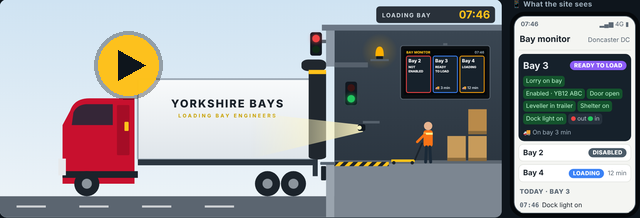 Bay monitoringWatch the same lorry on a loading bay with bay monitoring and without it – 40 minutes lost without.
▶ Watch how it works
Questions
What is a loading bay drive-away?
When a lorry pulls away from the loading bay while it's still being loaded or unloaded, often with equipment or people in the trailer or on the dock leveller.
What is trailer creep?
The trailer slowly moving forward as forklifts drive on and off it, which can open a gap between the trailer and the dock leveller lip. A wheel lock or vehicle restraint stops it.
Is key handover enough on its own?
It works well when goods-in always know when a bay is finished. Without that, drivers wait longer than they need to and ask around the yard - bay monitoring closes that gap.
Written by our loading bay engineers · updated 09/11/2026. This is general guidance - if in doubt, take the bay out of use and call us.