Manual wheel chocks
The cheapest option: a chock placed in front of the trailer wheel. It works if it's always used and always placed properly - but nothing stops the bay being used without it, and chocks go missing.
Sensor (smart) wheel chocks
A chock with a sensor that tells the bay controls it's in place. Interlocked, the door and leveller won't work until the chock is fitted, and the lights change to show it.
Wheel locks and vehicle restraints
A powered restraint mounted at the bay - in the ground at the wheel, or a hook on the rear of the trailer - operated from the bay controls. It's the most positive control: the bay only works once the trailer is held, and the lorry can't leave until the door is shut and the leveller parked.
Key handover
No hardware on the bay: the driver's keys stay with goods-in until the bay is finished. It suits sites with mixed vehicles or where restraints aren't practical, and with bay monitoring the bay is only enabled once the office has the keys.
Interlocks are what make any of them work
Whichever you choose, link it to the door, leveller and traffic lights so the bay can't be used without it. Our control panels do this as standard, and with bay monitoring you can see every bay's status - and any bypass - live.
Saves time, money – and makes loading safer
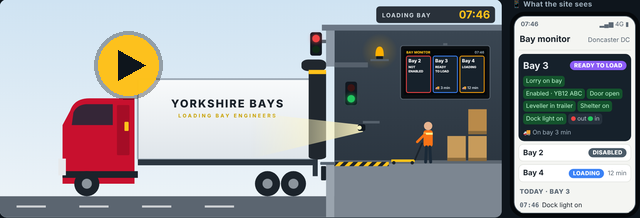 Bay monitoringWatch the same lorry on a loading bay with bay monitoring and without it – 40 minutes lost without.
▶ Watch how it works
Questions
What's the difference between a wheel chock and a wheel lock?
A wheel chock is placed by hand in front of the wheel. A wheel lock (or vehicle restraint) is a powered device fixed at the bay and operated from the controls, so it can be interlocked with the door and leveller.
Do wheel chocks stop drive-aways?
They stop trailer creep and make driving away harder, but a manual chock can be forgotten. Interlocked chocks, wheel locks or key handover give a more reliable control.
Can a wheel lock be added to an existing bay?
Usually, yes - restraints can be retrofitted and interlocked with your existing door, leveller and traffic lights.
Written by our loading bay engineers · updated 09/11/2026. This is general guidance - if in doubt, take the bay out of use and call us.